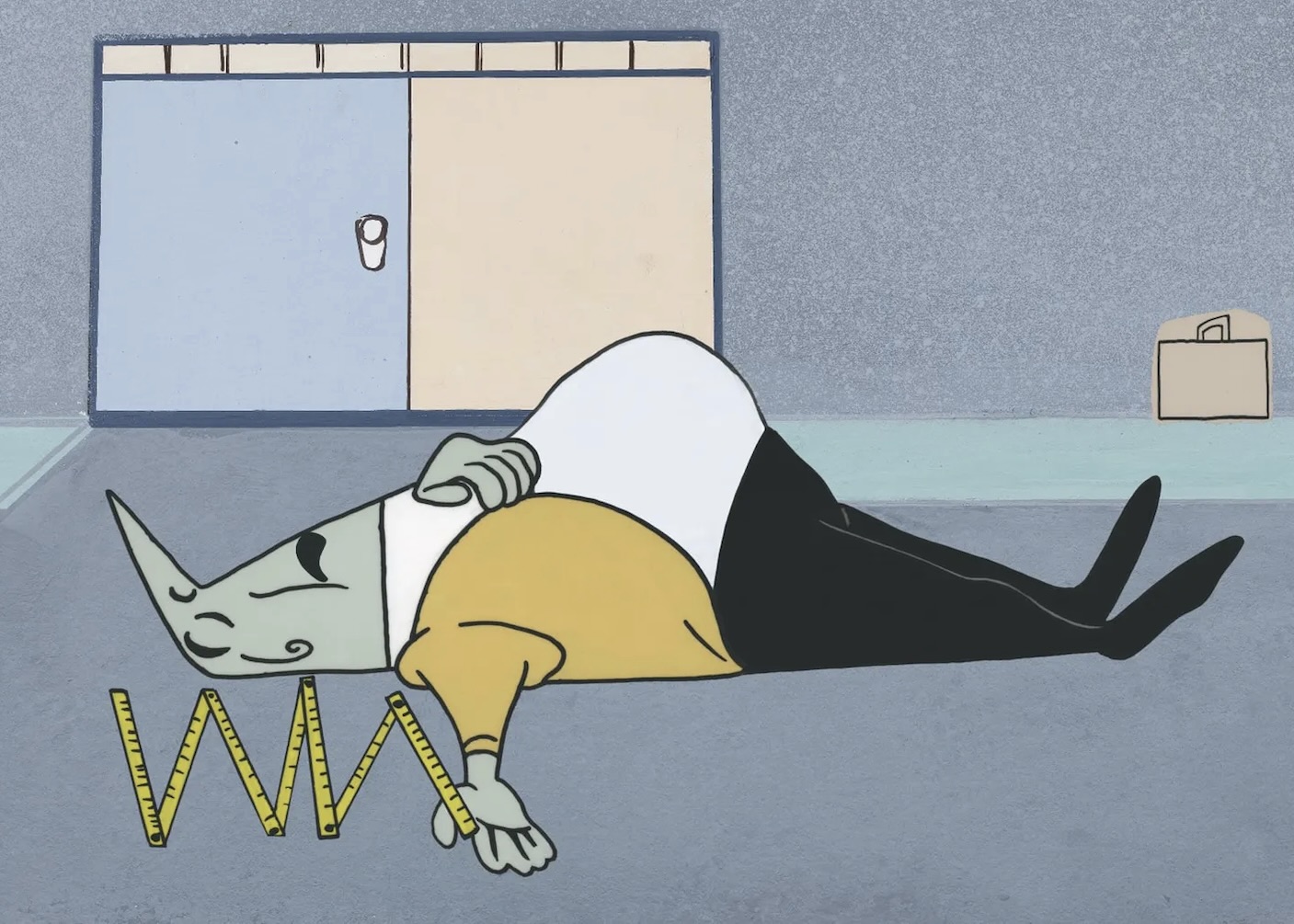
Following the length of traditional animation shorts that used to precede feature films in theaters, Julian Irlinger’s The Curtain of Time draws on mid-century modern animation aesthetics. Adopting the technique of cel animation, the work takes inspiration from the visual language of the acclaimed studios of UPA and the Zagreb School of Animated Film. Characterized by a radical economy of form—simplified geometric shapes, flat color fields, and repetitive movements—their style rejected the meticulous realism of contemporaries like Walt Disney. Instead, limited animation artists redefined the medium by incorporating influences from Bauhaus, Cubism, Expressionism and Surrealism. Though widely celebrated for their experimental approach, these studios also operated within propagandistic frameworks, producing films that served not only as entertainment but also as instruments of politics, industry, and the military.
If the history of cinema is closely intertwined with political interests, the same applies to urban planning. Every city’s design is shaped by decisions—from street layouts and the spaces allocated to cars to which architecture defines the landscape. In The Curtain of Time, Irlinger takes us on a journey through an architecture firm, which unfolds in a single continuous shot: a telephone rings, but nobody picks it up as the staff is asleep or sleepwalking.
With little action driven by the protagonists, the interior speaks volumes: a coat hanger evokes Joan Miró’s playful lines, while a speckled paravent alludes to Jackson Pollock’s abstract expressionism. Both evoke the artists’ entanglement with 20th-century politics, from Franco’s dictatorship in Spain to the CIA’s use of American modern art as a propaganda symbol during the Cold War. Elsewhere, models of iconic modernist buildings by Frank Lloyd Wright and Le Corbusier are discarded, while the sleeping architects’ drawing boards display blueprints of half-timbered houses. The film probes the renewed fascination in Germany with reconstruction architecture, and the socio-political stakes of rebuilding architecture lost in World War II—a movement seen by some as a means of preserving national identity and by others as a revisionist approach that seeks to cover up the fractures of history.
The looping format of the artist’s film reinforces the impression of history trapped in repetition, while the atmospheric soundscape goes beyond a purely illustrative function, giving the familiar form of animation an enigmatic, ambiguous quality. Just as the architects remain asleep, the weight of history lingers in this limbo, where the commodification of memory and the formation of national identity inform not only urban landscapes but also the collective unconscious.
– Liberty Adrien, Carina Bukuts
Julian Irlinger (b. 1986 in Erlangen, Germany) is an artist based in Berlin. He graduated from the Städelschule, Frankfurt am Main, in 2017. He previously studied Fine Art at the Academy of Fine Arts Leipzig from 2011 to 2014 and earned a BA in Art History from Friedrich-Alexander University Erlangen-Nuremberg in 2011. He participated in the Whitney Museum Independent Study Program, New York (2017–18), and the Berlin Program for Artists (2021–22). He is a participant in Manifesta 16 Ruhr (2026).
His recent institutional solo exhibitions include Portikus, Frankfurt am Main (2025), Kunstverein Schwerin (2025), the Wende Museum, Los Angeles (2022), Galerie Wedding, Berlin (2020), the Wilhelm Hack Museum, Ludwigshafen (2019), and Kunsthalle Darmstadt (2017). His work has recently been presented in international group exhibitions at PalaisPopulaire, Berlin (2025), Hamburger Kunstverein (2023), Art Basel Parcours, Basel (2023), Dortmunder Kunstverein (2022), Kunsthalle Baden-Baden (2018), Artists Space, New York (2018), MMK Frankfurt (2017), and Kunsthalle Wien, Vienna (2016).
The Curtain of Time was commissioned by Portikus, Frankfurt am Main, on the occasion of the exhibition Julian Irlinger: The Curtain of Time (curated by Liberty Adrien & Carina Bukuts), 2025.