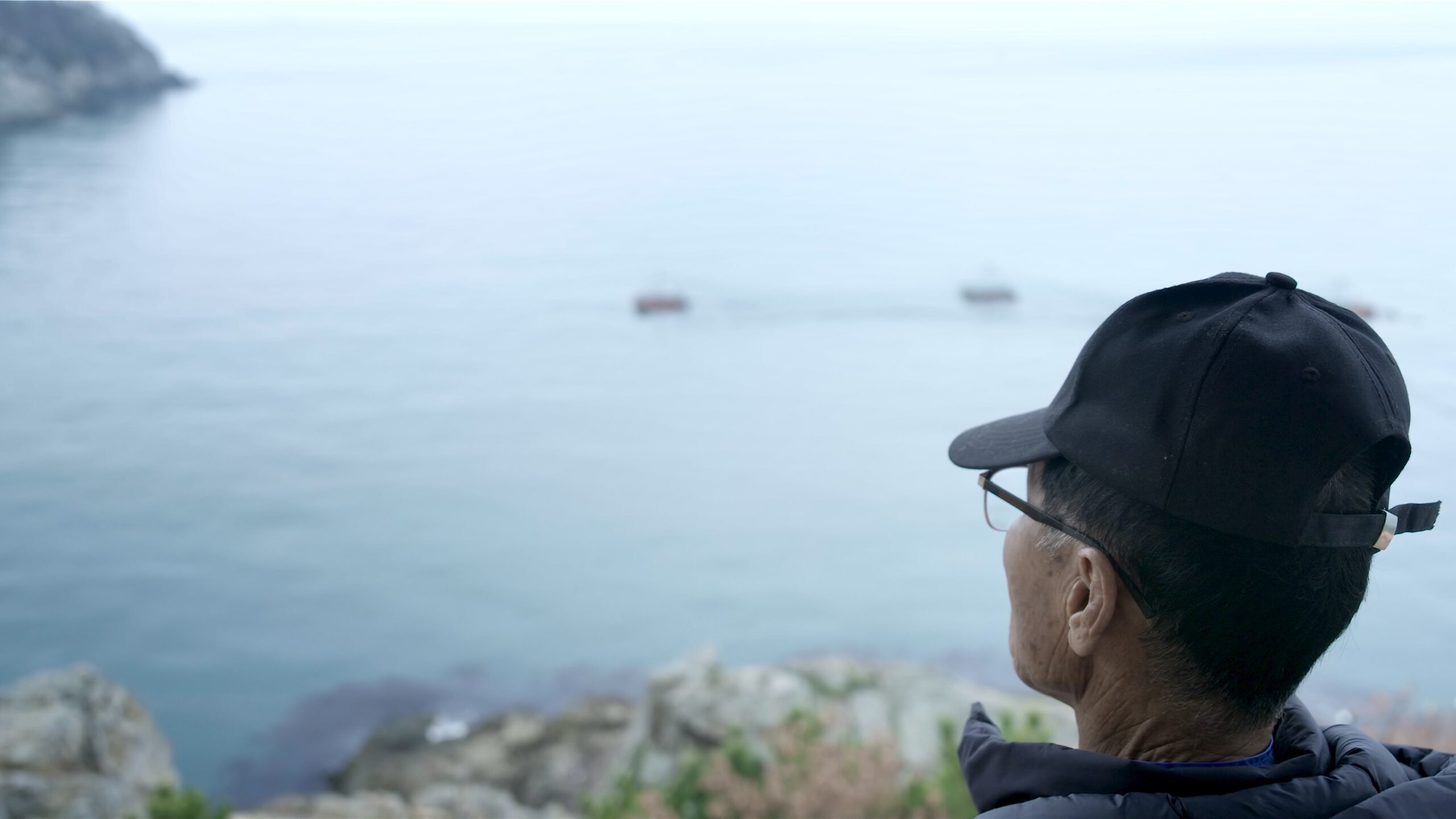
Every spring on Gadeok Island in Busan, South Korea—usually between March and May—an elderly man makes his way to the peak of a mountain to watch the sea for eight to ten hours a day. Like the men before him in this 200-year-old tradition, his gaze is uninterrupted: he eats watching the sea, pees watching the sea, and speaks to a rare visitor watching the sea. This man is a fish watcher, and he is on the lookout for a change of color on the water’s surface. When the ocean turns from a shimmering blue to a pastel pink he knows he must act. The rest of his crew are waiting silently on engineless boats down below, and as soon as the watcher signals, they must rapidly pull up their sunken nets. Every spring, swarms of gray mullet make their way to the island’s rivers to spawn, and only an experienced fish watcher can spot their pearlescent scales pulsing just below the surface.
Approximately 5,000 miles away, a young man walks along a stream in Berlin’s Tiergarten, on the lookout for his catch of the day. The anonymous protagonist skims the trees and bushes with a lustful gaze, searching for a glance returned. Pulsating (2026), the fourth episode of Young-jun Tak’s Ways of Lives (2022–ongoing), moves between the mountaintop and the covert of Berlin’s Tiergarten—the city’s large central park and one of its best-known cruising areas. Shot in CinemaScope format (2.39:1), the horizontally elongated ratio sharpens the focus on the central subject while engaging the viewer in a more direct, physical way. Each episode in the series follows two men traveling by car, plane, train, or on foot as they navigate masculinity, desire, and labor within their respective cultures.
Tak’s approach is psychological and his camera is always close, focusing on details and gestures that generate the film’s prolonged tension. He frames the watchers’ eyes forensically, holding their undisturbed and hungry gaze. The visuals are paired with organ music by the acclaimed 19th-century Notre Dame cathedral organist Louis Vierne, who was blind. Performed here by Berlin Cathedral organist Andreas Sieling, one of Tak’s regular collaborators throughout Ways of Lives, the interpretation of Adagio, Organ Symphony No. 3 in F-sharp minor, Op. 28 undulates between a sweet sadness and the chromatic, dissonant large chords that evoke a brooding suspense. Beyond the forest and the sea, the music reveals another kind of pulse—felt as our protagonists wait and wander in search of what they desire most. – Lisa Long
Young-jun Tak 탁영준 (born 1989, in Seoul, South Korea) lives and works in Berlin, Germany.
Solo exhibitions (selected): Galerie Nordenhake — Salon Kant. (Berlin, 2025), COMA (Sydney, 2024), Atelier Hermès (Seoul, 2024), Julia Stoschek Foundation (Berlin, Dusseldorf, 2023), palace enterprise (Copenhagen, 2023), Wanås Konst (Knislinge 2023), O—Overgaden (Copenhagen, 2023), SOX (Berlin, 2022), and Efremidis (Berlin, 2022).
International group exhibitions (selected): Seo-Seoul Museum of Art (Seoul, 2026), Art Sonje Center (Seoul, 2026), 8th Singapore Biennale (2025), 14th Taipei Biennial (2025), Kalmar konstmuseum (Kalmar, 2025), 24th SONGEUN Art Award (Seoul 2024), Fondazione Sandretto Re Rebaudengo (Turin 2024), 4th Bangkok Art Biennale (2024), 5th Chicago Architecture Biennial (2023), The High Line (New York, 2023), 16th Lyon Biennale (2022), Perrotin (Paris, 2022), KINDL Center for Contemporary Art (Berlin, 2022), 11th Berlin Biennale (2020), SeMA Bunker (Seoul, 2019), and 15th Istanbul Biennial (2017).